
The short answer depends on what “worth it” means to you. If you’re purely running a cost-per-year comparison against string lights from the hardware store, permanent outdoor lighting is a longer payback. But most homeowners who install a permanent system say the financial math wasn’t the main reason they did it. The value shows up in time, safety, convenience, and how often the lights actually get used once they’re up.
The Annual Holiday Lighting Cycle
Every November, millions of homeowners pull bins of tangled string lights out of storage, test which strands still work, climb a ladder in increasingly cold weather, and spend a weekend getting everything hung. Then in January, the whole process reverses. Between setup, testing, and teardown, most households lose somewhere between four and eight hours a year on seasonal lighting.
That doesn’t account for the mid-season fixes. A strand goes dark on one section. A clip breaks and a line sags. The timer stops working. The extension cord running along the soffit comes loose after a windstorm. These are small problems individually, but they repeat every year and each one requires another trip up the ladder or another run to the store.
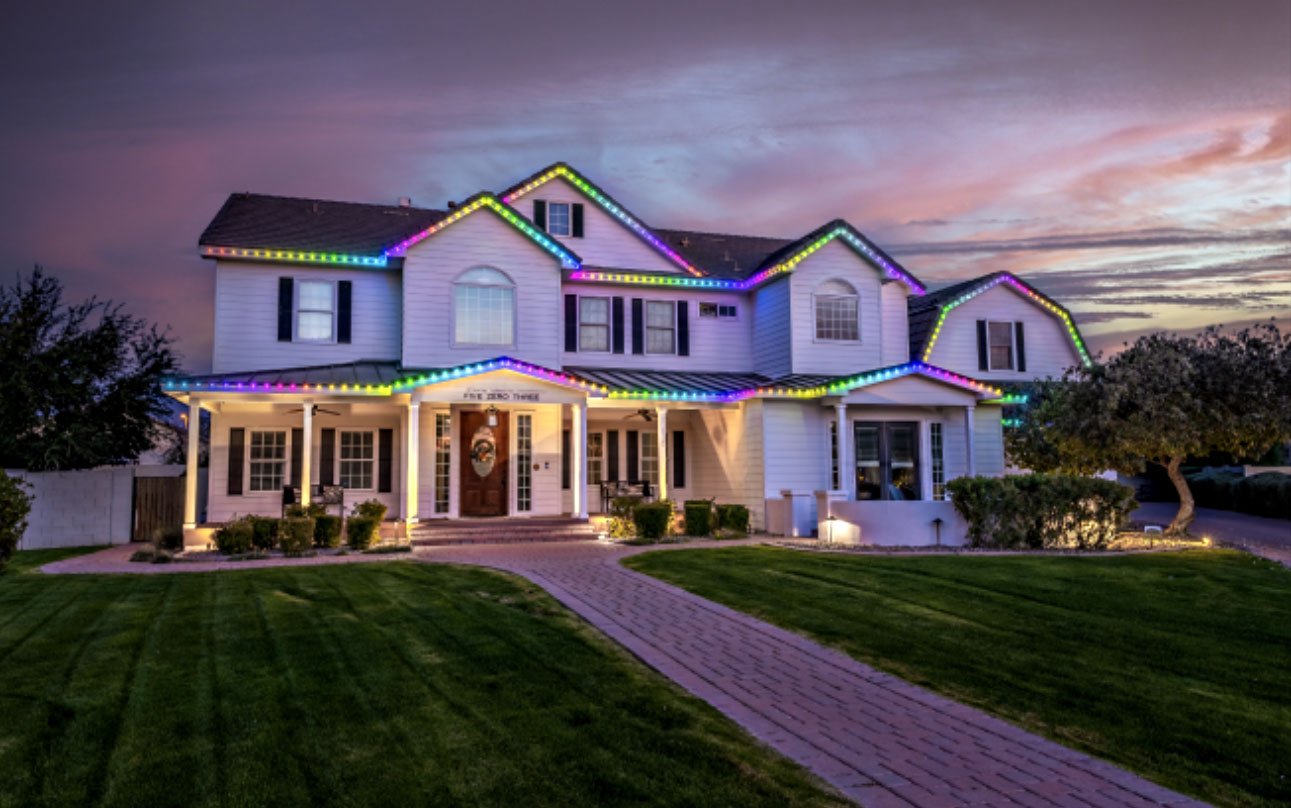
Permanent outdoor lighting eliminates that cycle entirely. The lights go up once and stay mounted year-round. Color changes, scheduling, and on/off control all happen through an app. The physical installation is a one-time project.
 Safety Is the Reason Most People Don’t Talk About
The U.S. Consumer Product Safety Commission reports approximately 160 decorating-related injuries per day during the holiday season, with close to half involving falls. That statistic covers the full population, but the risk concentrates on homeowners doing exactly this kind of work: climbing ladders in cold weather to hang or remove lights from rooflines and gutters.
A permanent LED system running on low-voltage power doesn’t carry those same risks once installed. There are no daisy-chained extension cords running along the soffit, no overloaded outlets, and no incandescent strands generating heat near dry materials. The ladder work happens once, during good weather, on your own timeline. After that, the ladder stays in the garage.
Year-Round Use Changes the Equation
Seasonal string lights serve one purpose: holiday decoration for roughly six weeks. A permanent system works 365 days a year. That shift in how long the lights get used is where the value calculation changes the most for homeowners who’ve made the switch.
Common uses beyond the holidays:
- Warm white accent lighting on any evening
- Team colors on game day
- Red and pink for Valentine’s Day
- Red, white, and blue for the Fourth of July
- Orange and purple for Halloween
- Custom colors for birthdays, graduations, or parties
The EverLights app handles all of this from a phone. Homeowners can set schedules, program scenes, and configure color zones without touching the lights physically. The system also integrates with Alexa and Google Home for voice control.
When homeowners report what surprised them most after installation, year-round use comes up consistently. The expectation going in is usually holiday lighting. The reality is that the warm white accent mode ends up running more nights than any holiday scene does.
Planning Tips Before You Buy
A few things to check before ordering to make sure the installation goes smoothly.
The system requires a power supply point roughly every 75 feet. Most homes already have exterior outlets in the right locations, but it’s worth verifying before you order. If you need one added, an electrician can handle it quickly and it’s a one-time cost.
If your home has an HOA, check the guidelines before purchasing. Most HOAs that restrict seasonal decorations have different rules for permanent architectural features, so it’s usually not an issue, but it’s worth confirming upfront.
Homes with strong street-facing rooflines get the biggest curb appeal impact, but the year-round functionality — accent lighting, holiday scenes, smart home integration — delivers value regardless of roofline visibility.
How the Technology Holds Up Over Time
LED technology rated at 50,000 hours under the L70 standard means the lights maintain at least 70% of their original brightness for roughly 17 to 23 years at typical daily use of six to eight hours. That’s not a marketing claim that requires fine print. The L70 standard is an industry measurement used by the Department of Energy to evaluate LED longevity.
EverLights ClickLights carry an IP67 waterproofing rating, which means fully sealed against dust and tested to survive submersion in one meter of water for 30 minutes. In practical terms, that covers rain, snow, ice, gutter runoff, and temperature extremes across seasons.
Operating costs stay low. LED permanent lighting systems use significantly less energy than traditional incandescent holiday lights. Running 150 feet of LEDs at six hours per day typically costs between $8 and $30 per year in electricity depending on local rates and brightness settings.
So Is It Worth It?
For homeowners who are tired of the annual cycle, concerned about ladder safety, or interested in lighting that works beyond December, permanent outdoor lights tend to be worth it. The value isn’t just financial. It’s the combination of time saved, risk eliminated, and a system that gets used far more often than seasonal lights ever did.
For a breakdown of what EverLights ClickLights include at each bundle size, visit the EverLights DIY page. For homeowners who’d prefer a fully installed solution, professional installation is available with a 5-year product warranty and 1-year labor warranty.